The structure of peoples hair PMC
Table Of Content

During the growth phase, an extra outer layer (stratum basale) appears. Androgenetic alopecia, which is known as male pattern baldness when it presents in men, is a condition that affects the growth cycle of hair follicles on the scalp. The hair cycle slows down and weakens, eventually stopping altogether. Hair serves a variety of functions, including protection, sensory input, thermoregulation, and communication. The hair in the nose and ears, and around the eyes (eyelashes) defends the body by trapping and excluding dust particles that may contain allergens and microbes.
What is a hair follicle?
The upper layers of the scalp can slide over the connective tissue beneath them, which is why the skin on your head has some ‘movement’. The suprabulb region extends from the hair bulb to the isthmus and consists of components of the hair shaft, IRS, ORS, vitreous layer, and fibrous root sheath. Although vellus hairs greatly outnumber terminal hairs, the latter are more important. Therefore, the discussion of hair anatomy in this article focuses on terminal hairs.
Grey's Anatomy
The resulting 2-dimensional X-ray intensity maps of the reciprocal space reveal exquisite details of the molecular structure of human scalp hair, as presented in Fig. The displayed (qz, q‖)-range was determined to cover the length scales of the features of interest in preliminary experiments. The individuals include men and women and hair of different appearance, such as thickness, colour and waviness, and also genetically related hair samples from a father and daughter, a pair of identical and a pair of fraternal twins. The cuticle is the outermost layer formed by flat overlapping cells in a scale-like formation (Robbins, 2012). These cells are approximately 0.5 µm thick, 45–60 µm long and found at 6–7 µm intervals (Robbins, 2012). The outermost layer of the cuticle, the epicuticle, is a lipo-protein membrane that is estimated to be 10–14 nm thick (Swift & Smith, 2001).
The Molecular Anatomy of Mouse Skin during Hair Growth and Rest - ScienceDirect.com
The Molecular Anatomy of Mouse Skin during Hair Growth and Rest.
Posted: Thu, 05 Mar 2020 08:00:00 GMT [source]
Where are hair follicles located?
The hairs of the scalp, eyebrows, and eyelashes are of separate types from these others and develop fairly early in life. On the scalp, where hair is usually densest and longest, the average total number of hairs is between 100,000 and 150,000. Human hair grows at a rate of about 0.5 inch (13 mm) per month.
The color of your hair follicle doesn’t relate to the color of your hair. Telogen effluvium is when hair roots are pushed into the telogen resting phase. This usually occurs after some stress and can be acute or chronic. Hair has many areas of clinical significance, which include diseases of hair loss, excess, alterations due to nutritional deficiencies, infectious causes, and effects of drug reactions.
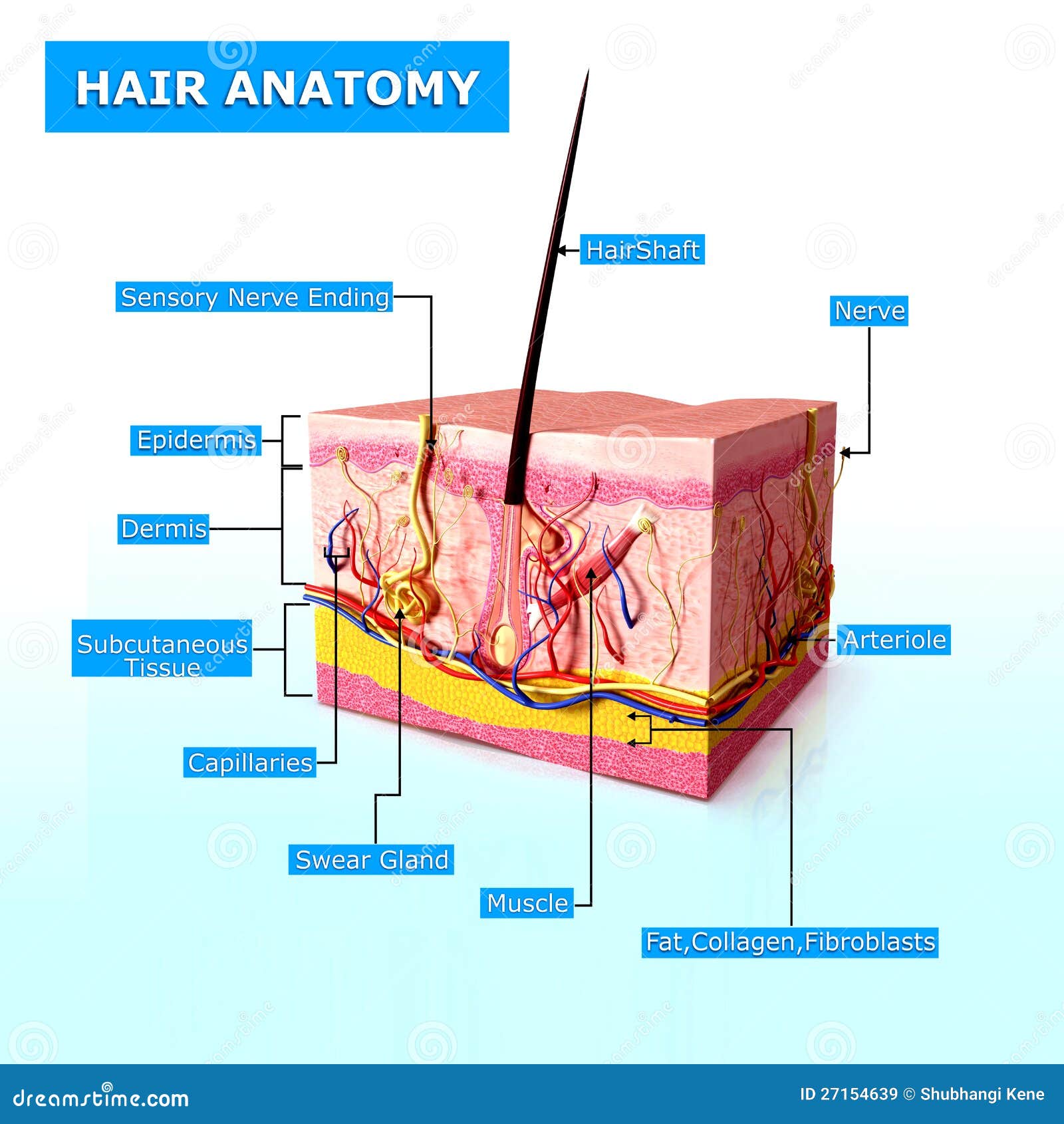
Telogen effluvium describes a disruption in the normal hair growth and rest cycles that results in excessive shedding and hair loss. This disorder is diagnosed by the hair pull test, which is positive when pulled hair easily is removed from the scalp, and 50% or more of the strands are in the telogen, or inactive, phase. This condition can be precipitated by physical stress, such as surgery or malnutrition, or by medical exposure, such as chemotherapy and common medications. Arrector pili muscles are a type of smooth muscle found at an angle to hair follicles. They are attached to the papillary layer of the scalp’s dermis and connective tissue.
Animal hair structure changes from summer to winter to fend off freezing weather, researchers show - Phys.org
Animal hair structure changes from summer to winter to fend off freezing weather, researchers show.
Posted: Sun, 17 Mar 2024 07:00:00 GMT [source]
General structural features from the X-ray experiments
Hair care routines differ according to an individual's culture and the physical characteristics of one's hair. Hair may be colored, trimmed, shaved, plucked, or otherwise removed with treatments such as waxing, sugaring, and threading. Many mammals have fur and other hairs that serve different functions. Hair also has a sensory function, extending the sense of touch beyond the surface of the skin. Guard hairs give warnings that may trigger a recoiling reaction.
While creating characters, as well as writing the first script, the series' writers had no character descriptions in mind, and hoped to cast the best actor available for each part. Rhimes has said that if the network had not allowed her to create characters this way, she would have been hesitant about moving forward with the series.[115] Female roles, in particular, were developed as multi-faceted characters. The series also shows drama and emotions focused on Meredith's life.
Hair loss can refer to increased daily hair loss, which a clinician will elicit by asking if the patient notices more hair on his or her pillow or more hair in the shower after bathing. Hair loss can also refer to apparent hairlessness, which a clinician will elicit by asking if the patient notices areas without hair or regions where hair seems to be less thick or provide less coverage. Teasing out this distinction is necessary to determine the correct diagnosis. The loose areolar tissue forms a loose connection between the epicranial aponeurosis and the pericranium.
The follicle remains in this stage until the hair germ which is responsive to anagen initiating signals from the dermal papilla, starts to show enhanced proliferative and transcriptional activity in late telogen, leading to the initiation of anagen [2, 39]. Several molecular pathways, growth factors, proteins and genes play substantial roles for the development of the hair follicle. Canonical (β-catenin dependent) WNT (wingless-type integration site) signals are candidates for the initial dermal message, and it is believed that they precede other activators and regulators of appendage development.
Lineage studies have proven that bulge cells are multipotent and that their progeny generate the new lower anagen hair follicle [21]. One of the most distinguishing features of stem cells is their slow-cycling nature, presumably to conserve their proliferative potential and to minimize DNA errors that could occur during replication. On entering the hair bulb matrix, they proliferate and undergo terminal differentiation to form the hair shaft and inner root sheath. They also migrate distally to form sebaceous glands and to proliferate in response to wounding [16, 20, 22]. They are tubular and are formed from multiple layers of epithelial cells.
Moreover the follicular papilla is an essential source of growth factors [1, 3, 16, 28]. The main component of the cortex is a keratin coiled-coil protein phase. The proteins form intermediate filaments, which then organize into larger and larger fibres. The common features observed in the X-ray data of all specimens are signals related to the coiled-coil keratin phase and the formation of intermediate filaments in the cortex, and the cell membrane complex. Signal assignment and corresponding length scales are shown in the figure.
Eumelanin is the dominant pigment in brown hair and black hair, while pheomelanin is dominant in red hair. Blond hair is the result of having little pigmentation in the hair strand. Above the dermal papilla is the hair matrix which consists of proliferating keratinocytes. These cells proliferate and gradually move upwards where they are keratinized to produce the hair shaft. The hair bulb comprises the expanded portion of the inferior hair follicle and contains the dermal papilla and hair matrix. It’s in the shape of a cylinder with a rounded bottom in your skin.
Dr. Herman selects Robbins for a fetal surgery fellowship and becomes her mentor. Differences in the X-ray data between individuals were observed in the wide angle region (WAXS) of the 2-dimensional data in Fig. Figure 7A shows a comparison between individual 3 and 4 to illustrate the effect. For an easy comparison, the original data were cut in half and recombined, such that the left half depicts individual 3, and the right half individual 4. The keratin proteins in the cortex are known to organize in bundles whose structures are dominated by α-helical coiled-coils (Pauling & Corey, 1950; Pinto et al., 2014; Yang et al., 2014).
The isthmus is the area between the sebaceous duct opening and the bulge. The bulge is an area of the follicle marked by the insertion of the arrector pili muscle. Also, the bulge contains several epidermal stem cells that are part of the outer root sheath and stain with CK19, CK15, and CD200.


Comments
Post a Comment